
How to Choose an AI Sales Agent: A 2026 Guide
Table of Contents
- What You Need to Know Before Choosing an AI Sales Agent
- Key Features to Evaluate in an AI Sales Agent
- AI Lead Qualification Tools: How They Work and What to Look For
- AI Sales Agent Integration Best Practices for Your CRM
- Understanding AI Sales Agent Pricing Models
- Step-by-Step Process for Selecting and Deploying Your Agent
- Common Mistakes to Avoid When Choosing an AI Sales Agent
- Conclusion
Last Updated: August 30, 2026
What You Need to Know Before Choosing an AI Sales Agent
An AI sales agent is an autonomous software system that handles lead qualification, outreach, and appointment booking through voice, SMS, or email without requiring manual intervention. These agents use natural language processing and large language models to conduct human-sounding conversations, enabling 24/7 prospecting and lead nurturing across your entire contact database.
The decision to deploy an AI sales agent isn't trivial. You're integrating a new layer into your sales stack, connecting it to your CRM, training your team, and managing the operational shift that comes with automating what was previously human-driven. Getting this wrong costs time and money. Getting it right transforms your ability to scale revenue without proportionally scaling headcount.
This guide walks you through exactly how to choose an AI sales agent that fits your business.
Key Features to Evaluate in an AI Sales Agent
When comparing AI sales agents, most platforms highlight voice capability, SMS integration, and email automation. Those are table stakes. What separates tools that deliver measurable results from those that don't is how these features perform in your actual workflow.
Human-sounding conversational ability is the first real differentiator. An AI agent that sounds robotic will get hung up on immediately. The agent needs to handle natural speech patterns, unexpected questions, and conversational tangents without reverting to scripted responses. Listen to demos and have the agent call you. If you're uncertain whether it's human or not, that's your baseline.
Speed-to-lead response time determines whether you capture intent when it's fresh. If your agent takes 30 seconds to respond to an inbound lead, you've already lost competitive advantage (hbr.org). Look for platforms that respond under 45 seconds consistently.
CRM integration depth is where many tools fall short. You need bidirectional sync: the agent pulls lead data from your CRM, qualifies the lead, and writes back results in real time. Evaluate whether the platform integrates natively with your specific CRM system, not just "most CRMs."
Customization of conversation flow determines whether the agent can follow your sales methodology. You need to define your ideal customer profile, qualifying questions, objection handling, and booking logic without requiring custom code.
Lead scoring and qualification logic should be transparent and configurable. The agent needs to score leads based on criteria that matter to your business: budget, timeline, authority, and fit with your services.
Compliance and data privacy controls are non-negotiable, especially for regulated outreach. TCPA-safe SMS engagement means the platform has built-in consent tracking, opt-out handling, and audit trails.
AI Lead Qualification Tools: How They Work and What to Look For
Lead qualification is where AI agents generate the most immediate ROI. Instead of your sales team manually calling through a list, the agent qualifies leads based on your criteria and only escalates matches to your ideal customer profile.
The agent initiates contact via voice, SMS, or email and asks predetermined qualifying questions designed to uncover fit, budget, timeline, and decision-making authority. As the lead responds, the agent evaluates answers against your qualification rubric in real time. If the lead qualifies, the agent attempts to book an appointment directly into your calendar. If not, it logs the interaction and moves on.
A sales representative might qualify 15-20 leads per day through manual calling (peer-reviewed research). An AI agent can qualify hundreds in the same timeframe, working 24/7 without fatigue or inconsistency.
What to look for in a lead qualification tool:
The platform should allow you to define your own qualification criteria, not force you into a generic framework. Your ideal customer profile for a fitness studio differs completely from a med spa qualifying new patients.
Real-time lead scoring matters. As the conversation unfolds, the agent should assign confidence scores based on how responses align with your criteria.
The ability to handle objections during qualification is important. If a lead says "I'm not interested right now," a good agent explores the objection rather than accepting it at face value.
Integration with your CRM should capture the full conversation context, not just the qualification result. Your sales team needs to see what was discussed, what objections came up, and what the lead's actual needs are.
AI Sales Agent Integration Best Practices for Your CRM
Integration is where most deployments either succeed or fail. A poorly integrated AI agent creates data silos and requires manual data entry. A well-integrated agent becomes an extension of your existing workflow.
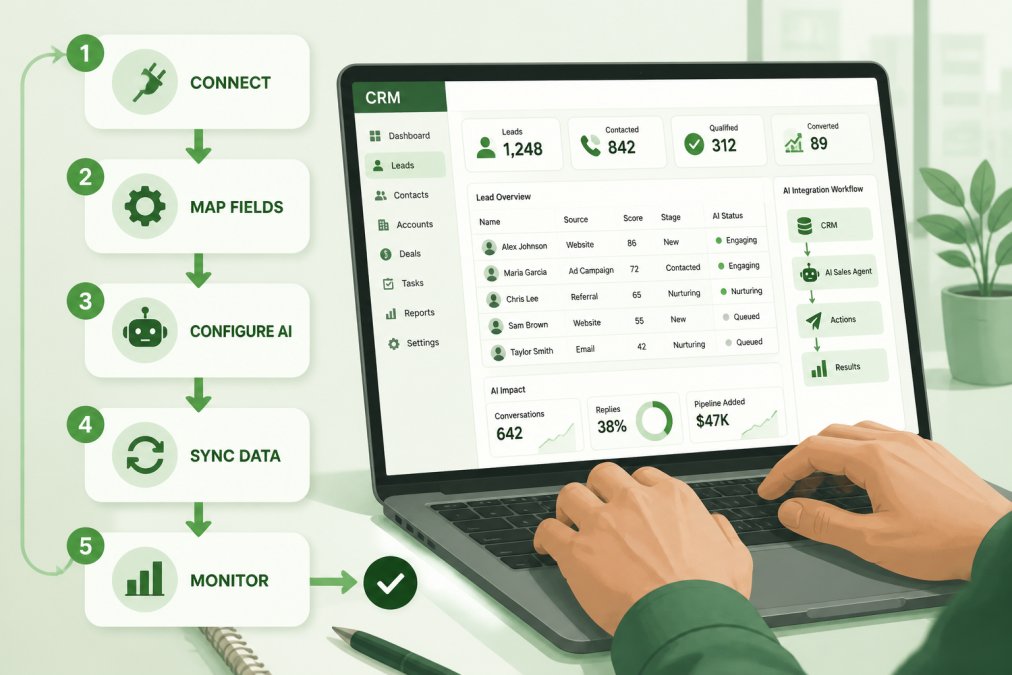
Start with data mapping. Document exactly what data flows where. Which fields in your CRM does the agent need to read? Which ones does it need to write back? This exercise prevents 80% of integration headaches.
Prioritize bidirectional sync. The agent should pull lead data from your CRM and write back results in real time. Your sales team always sees the most current information without manual updates.
Test with a small segment first. Start with 500-1,000 leads. Monitor the integration, verify data accuracy, and watch how your team responds to the new workflow before affecting your full operation.
Set up proper authentication and data access controls. The agent should only access the specific data it needs. This is both a security best practice and a compliance requirement.
Plan for conversation transcripts and audit trails. Every interaction should be logged and accessible for quality assurance, compliance documentation, and sales intelligence.
Define escalation rules clearly. Some conversations need immediate human handoff. Your escalation logic should be explicit: if X happens, escalate to Y team member.
Understanding AI Sales Agent Pricing Models
Pricing for AI sales agents varies significantly based on deployment model, volume, and feature set.
Most platforms use one of three pricing structures: per-contact pricing, per-minute pricing, or flat monthly pricing with included usage tiers.
Per-contact pricing charges based on the number of leads the agent contacts. This works well for defined, static lead lists and is predictable, but can become expensive quickly with large databases.
Per-minute pricing charges based on actual agent usage. This aligns cost with activity but creates unpredictability, a high-activity month costs significantly more than a quiet month.
Flat monthly pricing with usage tiers provides predictability while allowing flexibility. You pay a base fee that includes a certain number of contacts, minutes, or conversations, with overage fees for additional usage.
Beyond base pricing, evaluate what's included and what costs extra. Does the platform charge separately for CRM integration, SMS delivery, conversation transcripts, or API access? A platform that appears cheap initially might become expensive once you add necessary features.
Consider setup and implementation costs. Some platforms charge for custom configuration, training, and integration work. Others include these services.
Step-by-Step Process for Selecting and Deploying Your Agent
Choosing and deploying an AI sales agent is a structured process that reduces the risk of selecting the wrong tool or deploying it incorrectly.

Step 1: Define Your Sales Workflow and Objectives (Timeline: 1-2 weeks)
Map your current sales process from lead capture through appointment booking. Where are the bottlenecks? Where is manual work consuming the most time? Write down specific, measurable objectives. "Reduce time-to-contact for inbound leads from 24 hours to under 1 hour" is specific. "Recover $25K in revenue from inactive leads in 90 days" is concrete.
Step 2: Assess Your Current Data and Lead Database (Timeline: 1 week)
Audit your existing lead database. How many leads do you have? How current is the data? What percentage have valid phone numbers or emails? This assessment determines the scale of what you're working with and helps set realistic expectations.
Evaluate your current CRM system. Does it have an API? What data fields does it track? How is lead status managed?
Step 3: Identify Key Integration Requirements (Timeline: 1 week)
Document exactly how the AI agent needs to integrate with your existing systems. Does it need to pull lead data, write back qualification results, sync with your calendar, or create tasks?
List any compliance requirements specific to your industry. If you're doing outbound SMS, TCPA compliance is mandatory.
Step 4: Evaluate Platform Options (Timeline: 2-3 weeks)
Request demos from platforms matching your requirements. During demos, focus on real-world scenarios. Have the agent call you and attempt to qualify you as a lead. Test the platform's CRM integration with your actual system.
Evaluate customer support responsiveness and SLA for support requests.
Step 5: Run a Pilot Deployment (Timeline: 4-6 weeks)
Start with 500 to 1,000 leads. Deploy the agent and monitor performance closely. Track metrics that matter: contact rate, qualification rate, appointment booking rate, and lead quality.
Monitor your team's adoption. Do they trust the agent's qualification decisions? Early feedback is invaluable for adjusting behavior before full deployment.
Step 6: Optimize Based on Pilot Results (Timeline: 2-3 weeks)
Analyze what worked and what didn't. Did the agent's conversation flow match your sales methodology? Were qualification criteria accurate? Did CRM integration work smoothly?
Make adjustments to conversation logic, qualification criteria, or integration settings based on what you learned.
Step 7: Full Deployment and Monitoring (Timeline: Ongoing)
Roll out the agent to your full database. Establish ongoing monitoring: weekly reviews of performance metrics, monthly reviews of lead quality and conversion rates, quarterly reviews of ROI.
Maintain a feedback loop and continue optimizing based on real-world performance.
Common Mistakes to Avoid When Choosing an AI Sales Agent
Mistake 1: Choosing based on feature list instead of fit. Evaluate tools based on whether they solve your specific problem, not based on how many checkboxes they tick.
Mistake 2: Underestimating integration complexity. Data mapping, authentication, API limits, and field mismatches create friction. Budget extra time and resources for integration.
Mistake 3: Deploying without clear success metrics. Establish baseline metrics from your current process, then measure the agent's performance against those baselines.
Mistake 4: Expecting immediate results without optimization. Conversation flow, qualification criteria, and integration settings all need tuning. Expect a 4-6 week optimization period before peak effectiveness.
Mistake 5: Ignoring compliance requirements. TCPA violations can result in substantial fines (fcc.gov). Verify that any platform has built-in compliance controls and can document consent and opt-out processes.
Mistake 6: Failing to train your team. Your sales team needs to understand how the agent works, what data it provides, and how to act on that data.
Mistake 7: Choosing the cheapest option. A platform that's 30% cheaper but requires twice as much manual configuration ends up costing more in implementation time and frustration.
Choosing an AI sales agent requires balancing technical requirements, business objectives, and operational readiness. Start by understanding your own workflow, define clear success metrics, and evaluate tools against those specific criteria. SkyWebAI specializes in deploying autonomous AI sales agents that handle lead qualification, appointment booking, and database reactivation with human-sounding conversations and TCPA-safe SMS engagement. Our agents respond to leads in under 45 seconds and integrate directly with your CRM to eliminate manual data entry. If you're ready to recover revenue from your existing lead database without increasing ad spend, book a free session with our team to discuss your specific workflow and see how AI agents can scale your sales operation.
Frequently Asked Questions
Q: How do I know if an AI sales agent will sound human enough to get results?
A: The best AI sales agents use advanced natural language processing and large language models trained on real conversation data. Test the agent's voice and conversational flow before committing, most providers offer demos or trial periods. Listen for natural pauses, appropriate tone shifts, and ability to handle objections. Human-sounding agents can help recover significantly more leads because prospects engage longer before recognizing automation. Request references from similar industries (med spas, home services, fitness studios) to see real performance data.
Q: What's the actual ROI when choosing an AI sales agent for lead reactivation?
A: ROI depends on your lead database size, contact quality, and current conversion rates. AI agents can help businesses recover $10K-$100K+ from dormant leads without increasing ad spend by qualifying and booking appointments 24/7. Calculate your potential ROI by multiplying your database size by your average customer value, then subtract the agent's cost. Request case studies from your industry to benchmark realistic conversion rates before deployment.
Q: What security and compliance standards should an AI sales agent meet?
A: Your agent must comply with TCPA (Telephone Consumer Protection Act) regulations for SMS and voice outreach, including consent verification and opt-out handling. Verify the provider uses encrypted data transmission, secure API connections, and regular security audits. Request their security documentation and compliance certifications before integration. For healthcare and aesthetic businesses, confirm HIPAA compliance if handling patient data. Ask about data retention policies and whether lead information is stored securely or deleted after campaigns end.
Q: How much setup and management work is required on my team's side?
A: Setup complexity varies by provider. Full-service agencies handle configuration, CRM mapping, and testing with minimal input from your team, typically 2-4 hours of initial consultation. Self-service platforms require more hands-on work: defining workflows, uploading leads, and monitoring performance. Ongoing management is light, most agents run autonomously with weekly or monthly performance reviews. Choose a provider that offers dedicated support and clear documentation if your team lacks technical resources. Ask about training and whether they provide a dedicated account manager for your size business.
See how SkyWebAI's AI sales agents work for your business.