
How to Reactivate Old Sales Leads: A Step-by-Step Guide
Table of Contents
- Why Old Leads Matter: The Hidden Revenue in Your Database
- Defining Dormant Prospects and Stale Leads
- Step 1: Segment Your Database and Qualify Old Leads
- Step 2: Craft Cold Lead Re-engagement Email Templates
- Step 3: Build Your Sales Lead Reactivation Campaign Strategy
- Step 4: Choose the Best CRM Tools for Lead Nurturing
- Common Mistakes to Avoid When Reactivating Leads
- How Automation Accelerates Lead Reactivation
Last Updated: August 9, 2026
Why Old Leads Matter: The Hidden Revenue in Your Database
Your database contains money you've already paid to acquire. Most businesses treat old leads like digital waste, but dormant prospects represent recoverable revenue requiring zero new ad spend to unlock.
A med spa that generated 500 leads last year paid acquisition costs upfront. If 10% convert, that's revenue sitting idle. The same applies to home service companies with old quote requests, fitness studios with lapsed members, and call centers with prospects who went quiet after initial contact.
The challenge isn't recognizing old leads have value, it's executing reactivation systematically without sounding desperate or pushy. According to HubSpot's sales effectiveness research, companies implementing structured lead reactivation campaigns see measurable improvements in conversion rates and sales velocity.
At SkyWebAI, we've worked with businesses recovering $10K to $100K+ from dead lead databases using automated outreach that sounds human, respects compliance, and prioritizes empathy. This guide walks through the exact process: how to segment, qualify, and re-engage old sales leads without burning bridges.
Defining Dormant Prospects and Stale Leads
What Counts as a Dead Lead
A dormant lead is a contact who showed initial interest but hasn't engaged for 90+ days. These aren't random contacts, they requested information, attended a consultation, or filled out a form. They demonstrated buyer intent once.
A stale lead is colder, inactive for 6-24 months. Circumstances have likely changed: their needs evolved, competitors entered the market, or budget shifted.
Not every old contact deserves reactivation. A lead that bounced emails or asked to be removed belongs in a separate category. But a prospect who simply went quiet represents genuine opportunity.
Why Leads Go Cold
Understanding why leads went dormant helps you craft resonant messaging.
Timing misalignment is most common. A prospect needed your service in Q2, but your 60-day sales cycle meant they'd already solved it with a competitor by the time you followed up.
Budget constraints silence many prospects. A fitness studio member considered upgrading in January but allocated budget elsewhere.
Decision-making inertia keeps leads on ice. A prospect genuinely interested got busy, deprioritized the decision, and never circled back.
Competing priorities pull attention away. A business owner considering your service faced an emergency. By the time it resolved, your outreach had faded.
Poor initial experience kills momentum. If your first interaction felt pushy or misaligned with their needs, they deprioritized further conversation.
Understanding which category your dormant leads fall into changes how you approach reactivation.
Step 1: Segment Your Database and Qualify Old Leads
Before sending a single re-engagement message, segment strategically. Blasting everyone with the same template guarantees low response rates and damages sender reputation.
Identifying High-Value Prospects Worth Reactivating
Start by identifying which dormant leads deserve your time.
High-value criteria include:
- Demonstrated serious intent (requested consultation, asked specific questions, provided budget info)
- Industry/company profile matching your ideal customer
- Time since last engagement reasonable for your sales cycle (90-24 months)
- Valid contact information
- No explicit unsubscribe or "do not contact" request
A med spa's lead who booked a consultation is more valuable than someone who clicked one ad. A home service company's prospect who requested three quotes ranks higher than one who visited the website once.
Create a simple scoring system. Assign points for each criterion met. Leads above your threshold get prioritized; those below get archived or moved to nurture.

Using Lead Scoring to Prioritize Your Outreach
Lead scoring ranks prospects by conversion likelihood. For dormant leads, account for both original engagement level and time decay.
Scoring factors for old leads:
- Initial engagement quality (40% weight): How serious was their original interest?
- Time since last contact (30% weight): More recent dormancy is easier to reactivate.
- Fit with your offering (20% weight): Does their inquiry align with current services?
- Contact validity (10% weight): Can you actually reach them?
Segment into three tiers:
| Tier | Score Range | Reactivation Approach |
|---|---|---|
| Tier 1 (Hot) | 80-100 | Immediate personal outreach, multi-channel |
| Tier 2 (Warm) | 50-79 | Automated sequences, value-first messaging |
| Tier 3 (Cold) | Below 50 | Archive or long-term nurture only |
Tier 1 prospects get personalized email, phone call, or SMS from a real person. Tier 2 prospects get automated sequences that feel personal. Tier 3 prospects move to passive nurture.
Step 2: Craft Cold Lead Re-engagement Email Templates
Your re-engagement email determines whether a prospect opens the door. Success depends on subject line, opening line, and value proposition.
The Soft-Touch Opening Email
The soft-touch email acknowledges the time gap without awkwardness and provides a genuine reason for reaching out now.
Template:
Subject: Quick thought about [their specific situation]
Hi [Name],
I came across your profile and realized we haven't connected since [month/timeframe]. I was thinking about [specific challenge relevant to their industry], and your situation came to mind.
The reason I'm reaching out: [specific business update, new capability, or relevant development]. I thought it might be worth a quick conversation to see if it's relevant to what you're working on now.
If the timing works, I'd love to grab 15 minutes. No pressure if you're heads-down on other priorities.
[Your name]
Why this works:
- Acknowledges the gap without dwelling on it
- Provides legitimate reason for contact now
- Keeps the ask small (15 minutes, not a full demo)
- Respects their current priorities
- Avoids hard sell language
The Value-First Follow-Up
If the soft-touch email gets no response after 5-7 days, follow up with value-first messaging.
Template:
Subject: [Specific insight] for [their role/industry]
Hi [Name],
Quick follow-up on my previous note. I should have led with this instead.
We just analyzed [relevant data/trend] for [their industry], and one pattern jumped out: [specific, relevant insight]. It directly impacts [specific outcome: conversion rate, efficiency, revenue].
I put together a short breakdown here: [link to resource]. No sales pitch, just the data and what we're seeing work.
If you want to dig into how this applies to your situation, I'm around.
[Your name]
Why this works:
- Leads with utility, not a request
- Provides something they can use immediately
- Makes a second ask feel natural
- Positions you as knowledgeable, not desperate
The Break-Up Email Strategy
After two to three re-engagement emails with no response, a "break-up" email can work surprisingly well.
Template:
Subject: I'm going to stop emailing you
Hi [Name],
I'm going to keep this brief. I've reached out a few times, and I realize the timing might not be right, or I'm not solving a problem you actually have.
Rather than keep filling your inbox, I'm going to step back. But if things change on your end, or if you ever want to reconnect, just reply to this email. I'll be here.
Either way, no hard feelings.
[Your name]
Why this works:
- Removes pressure, which paradoxically increases response rates
- Shows respect for their inbox
- Keeps the door open for future contact
- Honesty often surprises prospects into responding
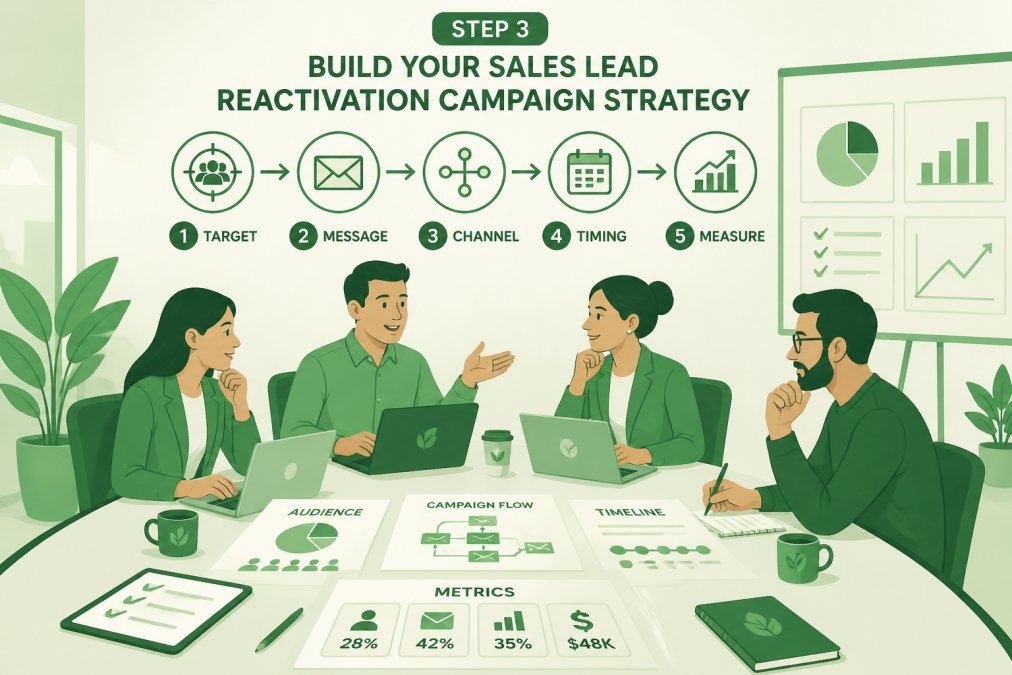
Step 3: Build Your Sales Lead Reactivation Campaign Strategy
A single email rarely reactivates a dormant lead. Reactivation works through a combination of channels, timing, and frequency.
Multi-Channel Engagement: Email, SMS, and Voice
Different prospects respond to different channels. A busy business owner might ignore email but answer a text. A consultant might prefer voice.
Email remains primary. It's non-intrusive, scalable, and leaves a written record.
SMS works for time-sensitive information. A med spa can text a lapsed member: "We've added the Hydrafacial you asked about. Still interested?" SMS has a 98% open rate but requires explicit opt-in and TCPA compliance.
Voice feels personal but requires careful execution. Call only after email or SMS priming.
Recommended sequence:
- Day 1: Email (soft-touch opening)
- Day 5: Email (value-first follow-up)
- Day 10: SMS (if opted in) with specific, time-bound offer
- Day 15: Voice call or voicemail (if appropriate)
- Day 20: Final email (break-up email or last-chance offer)
Setting the Right Follow-Up Cadence
A 5-7 day gap between touchpoints works well. This allows time for consideration without feeling like harassment.
Within a single campaign, limit to three to five touchpoints. After five attempts with no response, the prospect has signaled disinterest. Move them to passive nurture rather than continuing aggressive outreach.
Different seasons and industries affect cadence. A fitness studio reactivating members in January can be more aggressive than one reaching out in November. A home service company can push harder in spring than winter.
Timing Your Re-engagement Campaign
Avoid:
- Mondays (inboxes flooded)
- Fridays after 3 PM (people checking out mentally)
- Major holidays or industry events
- Prospect's known busy season
Ideal timing:
- Tuesday-Thursday, 9-11 AM (checking email but not overwhelmed)
- SMS: Weekday afternoons (2-4 PM)
- Voice: Mid-morning (10-11 AM) or early afternoon (2-3 PM)
Test different send times and adjust based on response rates.
Step 4: Choose the Best CRM Tools for Lead Nurturing
The right CRM platform automates reactivation workflows, tracks engagement, and ensures compliance.
Automation and Workflow Capabilities
Look for CRM platforms allowing conditional workflows. A good system lets you build: "If prospect opens email but doesn't click, send SMS on day 7. If they click, move to different sequence."
Key automation features:
- Email sequence builder with conditional branching
- Multi-channel orchestration (email, SMS, voice)
- Lead scoring that updates automatically
- Time-based and action-based triggers
- Reporting on response rates and ROI
Compliance and Data Safety Features
Reactivating old leads requires careful attention to compliance. GDPR and CAN-SPAM set hard rules on what you can send.
Critical compliance features:
- Unsubscribe management (easy removal, respected across channels)
- TCPA compliance for SMS (explicit opt-in, clear opt-out)
- GDPR data handling (for EU contacts)
- Audit trails (record of contact, timing, content)
- Consent management
According to FTC guidance on CAN-SPAM compliance, every marketing email must include a clear unsubscribe mechanism and physical business address. Violations carry fines up to $43,792 per email.
SkyWebAI's platform includes TCPA-safe SMS and multi-channel automation for lead reactivation at scale, with speed-to-lead response times under 45 seconds.
Common Mistakes to Avoid When Reactivating Leads
Ignoring Empathy and Personalization
The biggest mistake is sending the same template to everyone. Generic templates get ignored. Personalized outreach referencing something specific about their original inquiry gets responses.
Personalization checklist:
- Reference something from their original inquiry
- Acknowledge the time gap directly but briefly
- Lead with value relevant to their situation
- Use their name and company name
- Keep tone conversational
Personalized re-engagement emails typically see 2-3x higher response rates than generic ones.
Violating GDPR and CAN-SPAM Regulations
Compliance violations cost money and damage trust.
CAN-SPAM requirements (US email marketing):
- Every email must include physical business address
- Every email must include clear unsubscribe mechanism
- Unsubscribe requests honored within 10 business days
- Subject lines cannot be deceptive
- Identify message as advertisement if promotional
TCPA rules (SMS and voice):
- SMS to cell phones requires explicit prior written consent
- Calls cannot use automated dialers without consent
- Clear, easy opt-out required
- Calls only 8 AM-9 PM in recipient's time zone
- Identify yourself and company on call
GDPR rules (EU contacts):
- Consent must be explicit and documented
- Honor data deletion requests within 30 days
- Have legitimate business reason to contact
- Clear, accessible privacy policy
Over-Aggressive Follow-Up Frequency
Reaching out too often kills response rates and increases unsubscribes.
The rule: three to five touchpoints per campaign, spaced 5-7 days apart. After five attempts with no response, the prospect has communicated disinterest.
How Automation Accelerates Lead Reactivation
Manual outreach doesn't scale. Automation lets you reactivate hundreds or thousands of leads simultaneously while maintaining personalization and compliance.
Speed-to-Lead and Response Time
The faster you respond to a prospect's inquiry, the higher your conversion rate. When a dormant prospect sees your re-engagement message, they're in a moment of consideration. Slow response kills momentum.
Automation ensures immediate action. When a prospect opens an email, clicks a link, or replies, the system triggers the next step instantly.
SkyWebAI's system achieves speed-to-lead response times under 45 seconds. An AI voice agent can call a prospect within seconds of them clicking a link. An SMS can go out immediately after email engagement. This speed compounds response rates because you're reaching prospects while they're actively thinking about your business.
Manual outreach introduces delay. By the time a team member responds, the prospect's moment of interest has passed.
24/7 Engagement Without Manual Outreach
Your sales team sleeps. Prospects don't. A prospect in a different time zone might open your email at midnight and be ready for immediate conversation. Manual outreach can't respond then.
Automation works around the clock. An AI voice agent can call at 10 AM their time zone, whether it's 3 AM in your office. An SMS can deliver at optimal engagement time without manual scheduling.
This 24/7 presence means you're not losing leads to timing misalignment. Automation also reduces mental load on your sales team. Instead of managing hundreds of follow-up emails manually, they focus on high-value conversations with already-engaged prospects.
According to research on sales automation effectiveness, teams using automated lead nurturing see 50% more sales-ready leads at lower cost per lead.
Conclusion
Reactivating old sales leads is one of the highest-ROI activities a sales team can undertake. You've already paid to acquire these contacts. The revenue sits in your database waiting to be recovered, no new ad spend required.
The process is straightforward: segment by value, craft personalized re-engagement messaging, execute across multiple channels, and automate the workflow for speed and consistency. Compliance and empathy are non-negotiable.
SkyWebAI helps businesses at every stage of this process. Whether building workflows in your existing CRM or needing a full platform redesigned for lead reactivation, SkyWebAI's autonomous AI agents handle the volume while your team focuses on closing conversations. With TCPA-safe SMS, human-sounding voice agents, and speed-to-lead response times under 45 seconds, the system recovers the revenue sitting in your database, often $10K to $100K+ per business. Book a free session to see how your dormant leads can become active revenue.
Frequently Asked Questions
How long should you wait before trying to reactivate a lead?
Most sales professionals recommend waiting 30 to 90 days after the last meaningful contact before attempting reactivation. This window gives prospects time to reassess their needs without feeling pestered. However, leads dormant for 6+ months often require a different approach, acknowledge the gap with empathy rather than ignoring it. The key is segmenting your database by last contact date and tailoring your message accordingly. Leads from 3-6 months ago respond better to value-driven messaging, while truly old leads (12+ months) benefit from a genuine 'checking in' soft touch that doesn't assume prior interest.
How do you re-engage old leads without sounding desperate?
Focus on empathy and value, not urgency. Acknowledge the time gap directly ('I haven't reached out in a while, and that's on me') rather than ignoring it, then pivot to a genuine insight or resource relevant to their business. Avoid phrases like 'just checking in' or 'wanted to circle back', instead, lead with something concrete: a relevant article, a new capability that solves a past pain point, or a specific result you've achieved for similar prospects. Soft-touch re-engagement works because it removes pressure; you're offering value first and asking for the conversation second. This approach builds trust and dramatically improves response rates compared to aggressive follow-ups.
What is the best way to reach out to a cold lead after a long silence?
Use multi-channel engagement starting with email, then SMS, then voice if appropriate. Begin with a single, personalized email that references something specific about their business or past interaction, not a template. If no response in 5-7 days, send a brief SMS (with proper consent) offering a specific value proposition or resource. After another week, a human-sounding voice agent or call can work if you've established permission and compliance. The break-up email strategy also works well: after 2-3 touches with no response, send a final message saying you'll remove them from your list unless they indicate continued interest. This often prompts re-engagement from prospects who were simply overwhelmed or distracted.
What regulations do I need to follow when reactivating old leads?
In the United States, comply with CAN-SPAM (for email) and TCPA (Telephone Consumer Protection Act) for SMS and voice outreach. CAN-SPAM requires a clear unsubscribe option, accurate sender information, and honest subject lines. TCPA mandates prior express written consent for SMS and robocalls to cell phones, and restricts call times to 8 AM-9 PM recipient's time zone. For email, maintain accurate records of consent and honor opt-out requests immediately. GDPR applies if you're contacting prospects in the EU. The safest approach: verify consent status before reaching out, use dedicated compliance tools, and maintain audit trails of all outreach. Violations can result in significant fines, so working with a platform that handles TCPA-safe engagement is essential.
See how SkyWebAI's AI sales agents work for your business.