
How to Write Sales Follow Up Subject Lines That Get Opens
Table of Contents
- Why Most Sales Follow Up Subject Lines Get Ignored
- Best Practices for Sales Email Subject Lines
- Follow Up Email Subject Line Length: How Short Is Too Short?
- Sales Follow Up Email Templates You Can Adapt Today
- A/B Testing Your Sales Follow Up Subject Lines
- How to Re-Engage Dead Leads With Better Subject Lines
- Common Mistakes That Trigger Spam Filters and Kill Deliverability
- Conclusion
- Frequently Asked Questions
Last Updated: September 28, 2026
Why Most Sales Follow Up Subject Lines Get Ignored
Most sales follow up subject lines get ignored because they sound like every other pitch in the inbox. Buyers delete them before opening. The fix starts with understanding what makes someone stop scrolling and click.
Best Practices for Sales Email Subject Lines
The best practices for sales email subject lines come down to three things: relevance, brevity, and a reason to open now. Skip any one and the open rate drops.
Here is what to aim for:
- Write to one person, not a list
- Lead with value, not a request
- Keep it under 50 characters
- Match the preview text to the subject
- Avoid words that trip spam filters
Personalization That Goes Beyond First Names
Dropping a first name into a template is not personalization. Buyers see through it fast. Real personalization references their context: the quote they requested, the service they asked about, the date they went quiet.
Value-Driven Language and the Curiosity Gap
Value-driven language tells the reader what they get. The curiosity gap makes them want to find out. Use both, but do not lean on curiosity alone. A subject line that teases with no payoff reads like clickbait. Buyers ignore it.
Follow Up Email Subject Line Length: How Short Is Too Short?
The ideal follow up email subject line length is 30 to 50 characters. That range fits most mobile inboxes without getting cut off. Going shorter can work, but only when the meaning stays clear.
| Length | Character Count | Best For |
|---|---|---|
| Short | Under 30 | Warm leads, quick nudges |
| Ideal | 30-50 | Most sales follow ups |
| Long | 50-70 | Detailed offers, but risks truncation |
| Too long | Over 70 | Avoid; gets cut off on mobile |
Sales Follow Up Email Templates You Can Adapt Today
Use these sales follow up email templates as starting points, then swap in your own details. Never send a template as-is. The bigger mistake is using one template for every lead. A cold prospect and a warm one need different subject lines, because the relationship status sets what the reader will tolerate.
Cold vs. Warm Leads: Different Tone, Different Structure
A cold lead has no context for who you are. The subject line has to earn the open on relevance alone, which means naming the problem or the trigger event you noticed. A warm lead already knows you, so the subject line can lean on the shared history: the quote, the demo, the question they asked.
| Lead Status | Tone | Structure | Example Subject |
|---|---|---|---|
| Cold | Direct, specific, low-commitment | Trigger + relevance, no ask | Saw you opened a second location, quick question |
| Warm | Conversational, referencing history | Callback + light ask | Your [service] quote, one thing to confirm |
| Stalled | Low-pressure, opt-out friendly | Question + easy exit | Should I close your file? |
| Post-demo | Value reminder | Outcome + next step | The [outcome] plan we walked through |
Subject Lines by Funnel Stage
How to Adapt a Template Without Sounding Like a Template
Three edits turn a template into a real message. First, replace the bracketed placeholder with a specific detail the lead gave you, not a generic category. Second, cut the sentence that explains why you are following up; the reader knows. Third, read the subject line out loud. If it sounds like a mass send, rewrite it.
A/B Testing Your Sales Follow Up Subject Lines
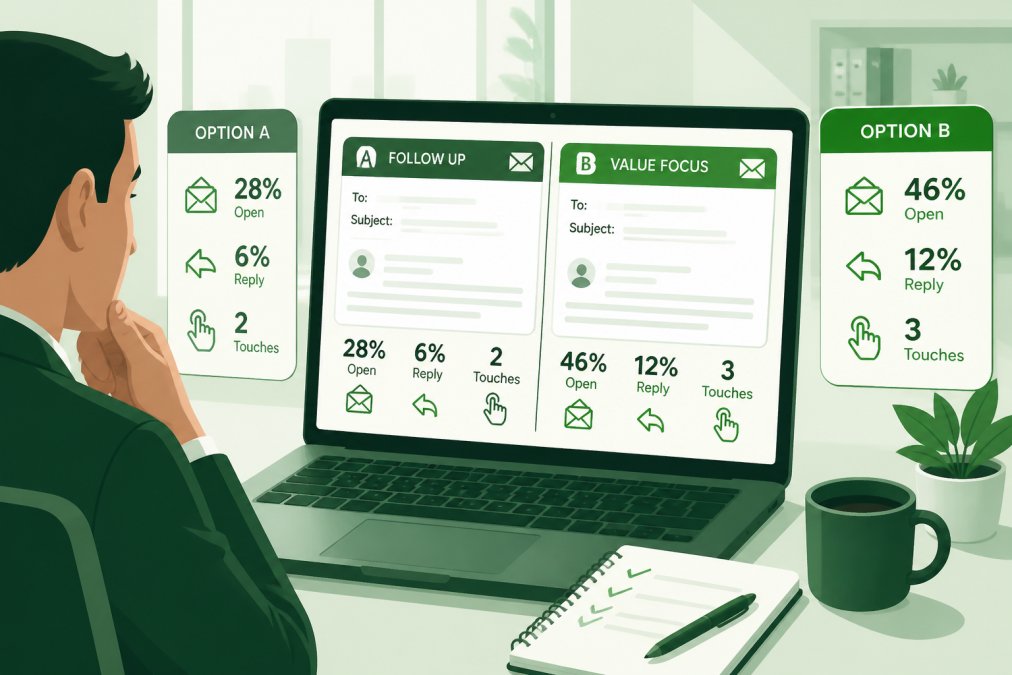
A/B testing your sales follow up subject lines is the only way to know what works for your list. Split your audience, change one variable, and measure opens. Most guides stop there. The part they skip is how to run the test so the result actually means something.
The Variable You Change First
Pick one variable per test. Common choices:
- Length (under 30 characters vs. 30-50)
- Tone (question vs. statement)
- Personalization (first name vs. company name vs. none)
- Ask (direct CTA vs. soft check-in)
- Preview text pairing
One variable at a time. If you change length and tone together, you learn nothing about either.
Sample Size and Test Duration
A test on 40 recipients proves nothing. Open rates swing wildly on small lists, so a two-point difference can be noise. A practical rule most practitioners use: do not call a winner until each version has at least a few hundred sends, and let the test run long enough to cover a full week so day-of-week behavior does not skew the result.
What to Measure Beyond Open Rate
Open rate is the headline metric, but it is not the only one. Track reply rate and click rate alongside it. A subject line can lift opens while lowering replies if it over-promises. The line that wins on opens but loses on replies is not the winner.
| Metric | What It Tells You | Watch For |
|---|---|---|
| Open rate | Whether the subject line earned attention | Apple Mail Privacy Protection inflates opens |
| Reply rate | Whether the message matched the promise | A drop here means the line over-promised |
| Click rate | Whether the body delivered on the subject | Low clicks with high opens signals a mismatch |
| Unsubscribe rate | Whether the tone pushed too hard | A spike means the line felt like a chase |
A Simple Testing Cadence
- Pick one variable, such as length or tone
- Split the list into two equal groups
- Send version A to group one, version B to group two
- Wait at least 24 hours, ideally a full week, then compare open and reply rates
- Keep the winner, then test the next variable
Run one test per sequence, not per send. Testing every email at once creates too many variables and no clean read. Many teams skip this step and guess instead. That guess costs opens every week.
Why This Beats Copying a Template List
A template library tells you what worked for someone else's list. A testing method tells you what works for yours. The two are not interchangeable. Use templates to generate hypotheses, then test them against your own audience. The teams that do this build a subject line playbook specific to their buyers, which no competitor's list can replicate.
How to Re-Engage Dead Leads With Better Subject Lines
To re-engage dead leads, drop the sales tone and lead with a question. Old leads went quiet for a reason. A pushy subject line confirms they were right to leave.
Try these angles:
- Ask if the timing is better now
- Offer something new since you last spoke
- Give them an easy way to opt out
- Reference the original request, not a generic pitch
Common Mistakes That Trigger Spam Filters and Kill Deliverability
Spam filters flag patterns, not intent. Even a good offer gets filtered if the subject line looks like bulk mail.
Avoid these:
- ALL CAPS and multiple exclamation points
- Words like "free," "guarantee," and "act now"
- Misleading lines that do not match the email body
- Too many links in a short message
- Sending to contacts who never opted in
| Mistake | Fix | Impact |
|---|---|---|
| ALL CAPS | Use sentence case | Lower spam score |
| Clickbait lines | Match subject to body | Better trust, fewer reports |
| Unverified list | Confirm opt-ins | Protects sender reputation |
| Too many links | Limit to one CTA | Improves deliverability |
Conclusion
Writing sales follow up subject lines that get opened is a repeatable skill, not luck. Keep them short, make them relevant, and test one change at a time. The teams that win here treat every follow-up as a chance to earn one more second of attention.
Frequently Asked Questions
What is the best subject line for a follow-up email?
There is no single best subject line, but the strongest follow-up subject lines share three traits: they are under 50 characters, they reference something specific to the recipient, and they avoid generic phrases like 'Just checking in.' A subject line such as 'Quick question about your Q3 goals' outperforms 'Following up' because it signals relevance and gives the reader a reason to open. Test two or three variations with your audience to find what resonates.
How long should a sales follow up subject line be?
Aim for 30 to 50 characters. Mobile email clients typically display 30 to 40 characters before truncating, so front-load the most important words. If your follow up email subject line length exceeds 60 characters, the tail end may never be seen. Keep it short enough to read at a glance but specific enough to spark curiosity. Character count matters more than word count because spacing and punctuation affect display.
How do you write a follow-up email after no response?
After no response, shift the angle rather than repeating the same message. Reference a new piece of value, a relevant result, or a time-sensitive reason to reply. For example, instead of 'Following up again,' try 'Saw this and thought of your team.' Keep the tone conversational and give the reader an easy out. A follow-up cadence of three to five touches over two to three weeks works for most sales cycles.
How can I re-engage dead leads without sounding desperate?
Lead with value, not urgency. Subject lines that offer a resource, a relevant case study, or a simple question about their priorities perform better than guilt-based phrasing. For dead leads, try a subject line like 'Still thinking about this?' or 'One idea for [their company].' Personalization and a conversational tone signal that you remember them as a person, not a record in a database. Keep the first touch low-pressure and easy to respond to.